
If you are a COO, CFO, or Controller at a mid-market eCommerce company, you have probably sat through at least one meeting where someone described your integration stack as “an IT thing.” Maybe you nodded, maybe you pushed back. But here is the reality that I have seen play out across hundreds of implementations: the companies that treat integrations as IT projects are the same ones calling us six months later, wondering why their order-to-cash cycle is still a mess.
I spent years building SuiteCommerce inside NetSuite. I watched companies pour resources into getting their ERP live, only to bolt on integrations as an afterthought. And what I learned during that time has shaped everything we do at Hairball: integration is not plumbing. It is the circulatory system of your business. When it fails, nothing else works.
The IT Project Trap
Here is how the typical scenario plays out. A fast-growing eCommerce brand finally outgrows its duct-tape stack of spreadsheets and manual processes. They invest in NetSuite. They pick Shopify or BigCommerce for the frontend. They choose a 3PL to handle fulfillment. Each of those decisions is made by a different stakeholder, on a different timeline, with a different vendor involved.
Then someone says, “We need to connect all of this.” And the project gets handed to IT, or to a systems integrator who treats it as a technical implementation. Map some fields. Build some flows. Test. Go live. Done.
Except it is never done. Within weeks, the finance team is chasing discrepancies between Shopify orders and NetSuite invoices. The warehouse team is shipping orders that were already cancelled. The customer service team is telling customers their orders shipped when they have not left the dock. And the leadership team is staring at dashboards they no longer trust.
This is not a technology failure. It is a process failure that was baked in from the start, because nobody asked the operational questions before the technical ones.
What Operations-First Integration Looks Like
When we work with clients at Hairball, we start with the business process, not the API documentation. Before a single flow gets built in Celigo, we want to understand how orders move through the organization. Who touches them, when, and why. Where does data get created, where does it get consumed, and what happens when something goes wrong.
This might sound obvious, but you would be surprised how rarely it happens. Most integration projects start with a field mapping spreadsheet and a list of endpoints. That is like trying to build a house by starting with the electrical wiring. You need the blueprints first.
Take a common scenario: a brand selling on Shopify, Amazon, and their own DTC site, fulfilling through a 3PL, and running their back office on NetSuite. The number of data handoffs in that ecosystem is staggering. Orders flow in from three channels. Inventory needs to sync across all of them in near real-time. Fulfillment confirmations need to flow back to the right channel so customers get tracking information. And all of it needs to land in NetSuite in a way that the finance team can actually close the books without spending a week reconciling.
If you approach that as a series of point-to-point connections, you end up with a brittle web that breaks the moment any single system changes an API or updates a data format. If you approach it as an operations architecture, you design for resilience. You build flows that know what to do when an order comes in with a missing SKU, or when a 3PL sends back a partial shipment, or when a marketplace changes its fulfillment SLA overnight.
The Cost of Getting It Wrong
Let me put some numbers around this, because “integration issues” can sound abstract until you see the financial impact.
One pattern we see regularly involves inventory overselling. A brand has 50 units of a popular item. They sell 30 on Shopify, 15 on Amazon, and 10 through their wholesale channel. That is 55 units sold against 50 available. If inventory sync is even 15 minutes behind, this happens. The cost is not just the five cancelled orders. It is the negative reviews on Amazon, the hit to your seller rating, the customer service hours spent apologizing, and the wholesale partner who now questions your reliability.
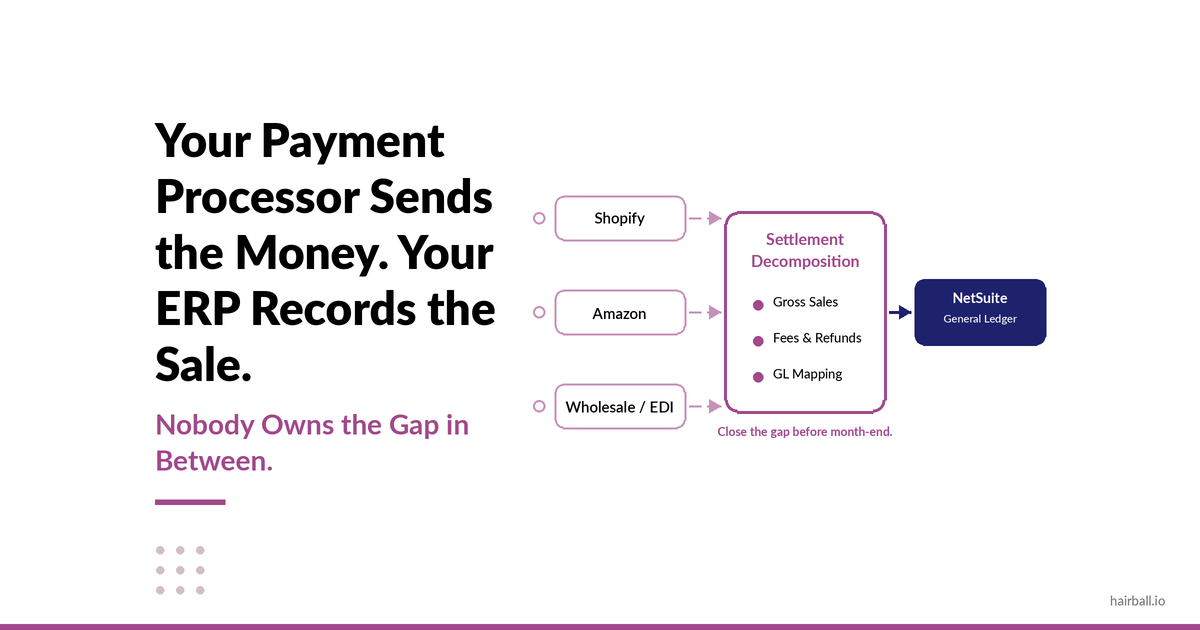
Another common pattern involves payment reconciliation. If your integration does not properly map payment methods, discounts, taxes, and refunds between your ecommerce platform and your ERP, your finance team ends up doing manual reconciliation. I have seen companies where two full-time employees spend 60% of their time reconciling orders that should have been matched automatically. That is not a rounding error on your P&L. That is real headcount doing work that a properly architected integration would eliminate.
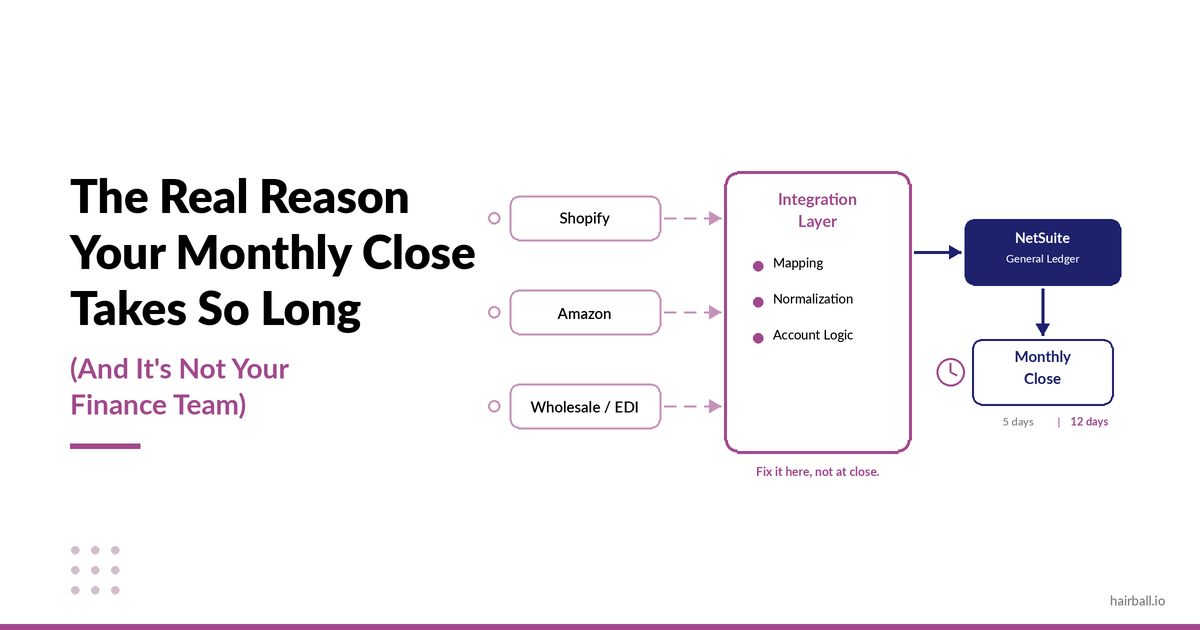
And then there is the month-end close. If your integration is dropping orders, duplicating transactions, or misapplying revenue, your Controller is spending days tracking down variances instead of providing the analysis your business needs to make decisions. Every day your close is delayed is a day you are flying without instruments.
Why This Matters More at Scale
Here is the thing that catches most growing companies off guard: integration problems do not scale linearly. They scale exponentially. When you are doing 500 orders a day, a 2% error rate means 10 orders that need manual attention. When you hit 5,000 orders a day, that same 2% is 100 orders. And by that point, your team is so busy firefighting that nobody has time to fix the root cause.
This is why we push our clients to think about integration operations from day one. The decisions you make when you are processing 500 orders a day will either support or sabotage you when you are processing 5,000. The flows you build, the error handling you design, the monitoring you put in place, all of it compounds over time.
At Hairball, we have the advantage of being a top Celigo implementation partner, which means we have built and maintained integrations across hundreds of eCommerce environments. Celigo gives us a powerful platform to work with, but the platform is only as good as the thinking behind the implementation. A well-designed integration on Celigo can handle millions of transactions reliably. A poorly designed one will create as many problems as it solves.
The Shift That Changes Everything
The companies that get this right share one common trait: they stop thinking about integration as a project with a start and end date, and start thinking about it as an ongoing operational discipline. Just like you would never “finish” managing your supply chain or “complete” your financial operations, integration is something that needs continuous attention, optimization, and investment.
This does not mean it needs to be expensive or complicated. It means you need the right architecture from the start, the right monitoring to catch issues before they hit customers, and the right partner who understands both the technology and the business processes it supports.
When I talk to COOs and CFOs about this, the ones who get it immediately are the ones who have already been burned. They have lived through the late-night fire drills when their 3PL connection goes down during a flash sale. They have sat through board meetings trying to explain why their numbers do not match across systems. They have watched their team burn out on manual workarounds that should have been automated.
The good news is that fixing this is entirely achievable. It starts with an honest assessment of where your integration stands today, not from a technical perspective, but from an operational one. Which business processes depend on your integrations? What happens when they fail? How quickly can you detect and resolve issues? And most importantly, is your current setup designed to support where your business is headed, or just where it has been?
Where to Start
If any of this resonates, here is what I would suggest. Pull your operations, finance, and technology teams into a room together. Map out your order-to-cash process end to end. Identify every point where data moves between systems. Then ask a simple question at each handoff: what happens when this breaks?
The answers will tell you whether you have an integration strategy or just a collection of connections. And that distinction is the difference between a business that scales smoothly and one that hits a wall every time it grows.
At Hairball, this is the work we do every day. As a NetSuite continued success provider and one of Celigo’s top implementation partners, we have helped hundreds of eCommerce brands turn their integration from a source of friction into a competitive advantage. If your integration is creating more work than it eliminates, it is time to rethink the approach.