
For product brands selling through Amazon Direct Fulfillment, operational precision is non-negotiable. When shipment confirmations fall out of sync (even for reasons outside your control), Amazon does not make exceptions.
Recently, we supported a fast-growing consumer packaged goods (CPG) brand through a go-live that addressed a critical operational risk: late shipment penalties caused by status mismatches between NetSuite and Amazon.
The engagement centered on establishing control, visibility, and automated reconciliation between systems that must operate in lockstep.
If you operate in food & beverage and rely on Amazon Direct Fulfillment, this scenario will likely feel familiar.
When “Fulfilled” in NetSuite Doesn’t Mean “Shipped” in Amazon
In an ideal flow:
- A customer places an order on Amazon.
- The order flows into NetSuite.
- The warehouse fulfills the order.
- The carrier scans the label.
- Amazon updates the order status from New to Shipped.
In practice, external variables interfere. Weather disruptions, carrier delays, scanning failures, or temporary logistics bottlenecks can interrupt the final step.
In this case, a large-scale disruption delayed carrier scans. Orders were picked, packed, and loaded. NetSuite reflected completed Item Fulfillment records. However, Amazon continued to display those same orders as New.
Once the “ship by” date passed, Amazon automatically flagged them as late.
Hundreds of late shipment flags appeared in a single cycle. Seller performance metrics were immediately at risk. The operations team was forced into manual remediation, confirming shipments one by one.
At scale, this is unsustainable.
The Root Issue: No Automated Status Reconciliation
The technical gap was clear:
- NetSuite accurately reflected fulfillment activity.
- Amazon required shipment confirmation triggered by carrier scan or explicit confirmation.
- No automated comparison existed between the two systems.
- Exception handling relied entirely on manual review.
Manual confirmation may be manageable when exceptions are rare. When hundreds of orders require intervention, the process becomes both inefficient and operationally risky.
A synchronization control layer was missing between Amazon and NetSuite.
The Solution: Amazon Direct Fulfillment Reporting & Automation
We implemented a structured automation flow between NetSuite and Amazon, focused on exception detection and controlled remediation.
Shipment Status Validation Flow
For every NetSuite Item Fulfillment record created, the system now:
- Queries Amazon for the corresponding order status
- Classifies the response into defined states:
- Empty (not yet checked)
- Shipped (aligned)
- New (misaligned and potentially at risk)
This provides immediate visibility into discrepancies before SLA deadlines are breached (late shipment penalties).
Operations teams can report specifically on fulfilled orders that Amazon still considers unshipped, turning a reactive fire drill into a manageable queue.
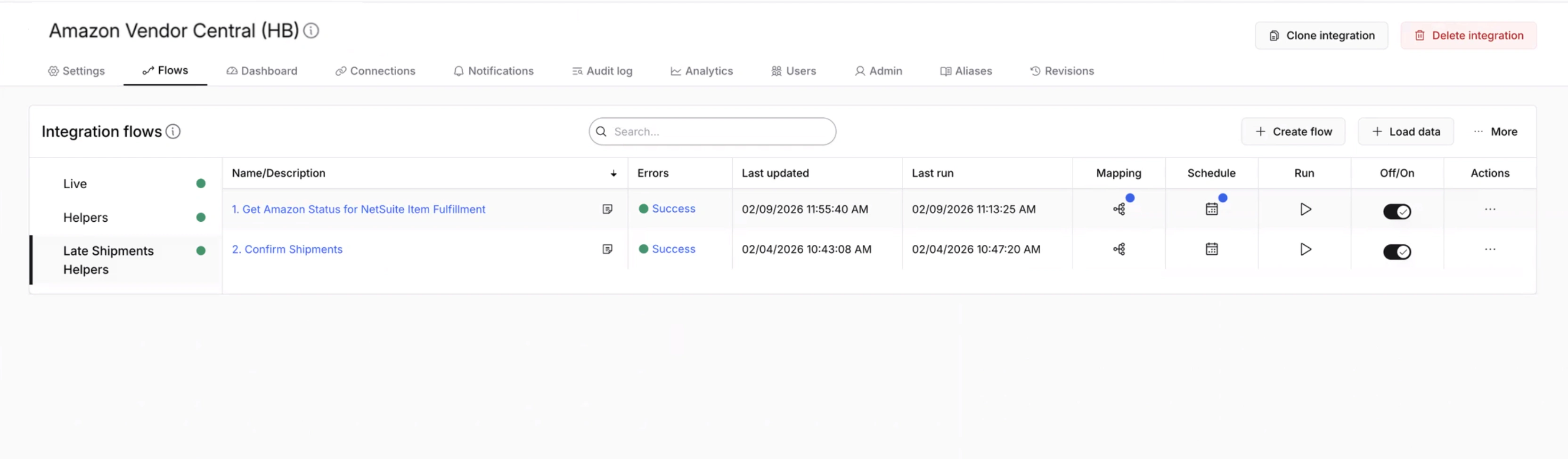
Automated Shipment Confirmation
For orders where:
- NetSuite shows fulfillment completed
- Amazon still shows status “New”
The integration can programmatically confirm the shipment back to Amazon.
Instead of manually confirming hundreds of orders, the integration:
- Identifies only the affected subset
- Confirms shipment where appropriate
- Preserves data integrity across systems
This transforms a reactive, manual process into a controlled, automated workflow.
Relevance for Scaling Product Brands
Mid-size or enterprise brands often operate in a narrow tolerance band:
- High marketplace volume
- Tight ship-by SLAs
- Limited operational buffer
- Direct exposure to Amazon performance metrics
It’s critical to understand that marketplace enforcement is automated, and this is where integration strategy becomes a competitive advantage.
Structural Improvements Introduced at Go-Live
This go-live was not just about fixing one incident. The integration enhancement created three durable capabilities.
1. Operational Visibility
Teams now have access to reporting that isolates:
- Fulfilled orders not yet marked as shipped
- Orders approaching SLA deadlines
- System-level status mismatches
Automation is applied selectively, only when fulfillment exists in NetSuite and Amazon remains in a risk state.
2. Exception-Based Automation
Only orders that meet specific criteria trigger automated action. Operations teams can now report on:
- Fulfilled orders not marked as shipped
- At-risk shipments before the SLA expires
- Status discrepancies across systems
This reduces repetitive manual workload while maintaining confidence in the integrity of shipment records.
3. Scalable Integration Framework
The architecture can be extended to support:
- SLA threshold alerts
- Marketplace-specific exception dashboards
- Carrier-level analytics
- Multi-channel fulfillment monitoring
The solution functions as a foundation, not a temporary fix.
A Practical Implementation Timeline
In this case, the deployment moved quickly due to:
- Clear data structures in NetSuite
- Defined Amazon Direct Fulfillment endpoints
- A well-scoped reconciliation logic
For brands implementing proactively, the process can be documented, tested, and embedded into a broader integration governance framework.
This type of enhancement does not require a full ERP redesign. It requires clarity on exception states and disciplined automation design. It is a focused integration enhancement with measurable impact.
What to Evaluate in Your Own Amazon–NetSuite Stack
If you are operating Amazon Direct Fulfillment, ask:
- Do fulfilled NetSuite orders automatically reconcile against Amazon shipment status?
- Can you isolate “fulfilled but not shipped” discrepancies in real time?
- Are bulk confirmations still manual?
- Do you have marketplace-specific SLA reporting?
- Are we protected against external disruptions (weather, carrier delays, scanning issues)?
If the answer to any of these is unclear, there is likely operational risk embedded in your current flow.
Integration as Risk Mitigation
As marketplaces grow stricter, operational tolerance narrows. Performance enforcement is algorithmic, immediate, and rarely contextual.
Amazon will continue to automate enforcement of performance metrics. The brands that thrive will be those that:
- Instrument their integrations
- Monitor exception states
- Automate corrective actions
- Treat ERP–marketplace sync as mission-critical infrastructure
When these elements are in place, disruptions become manageable events rather than systemic threats.
When operating on Amazon Direct Fulfillment, that level of control is increasingly table stakes. And infrastructure, when designed properly, becomes invisible, because nothing breaks.