
When a product brand starts selling through grocery distributors, the order paperwork changes. The purchase orders and invoices that move between a supplier and a grocery buyer follow their own ANSI X12 document standards, the EDI 875 and the EDI 880. Collin Street Bakery, the Texas-based maker known for its DeLuxe fruitcakes and pecan products, recently went live on both transactions with C&S, one of the largest grocery distributors in North America. The integration was built by Hairball, a Celigo and NetSuite partner, and runs straight through to NetSuite with no manual rekeying.
This post explains what the 875 and 880 are, how the grocery order-to-cash flow works end to end, and what it takes to connect those documents to NetSuite cleanly.
What Are EDI 875 and EDI 880?
EDI 875 and EDI 880 are ANSI X12 document standards used mainly in the grocery and retail industry to automate the order-to-cash process. The 875 places the order. The 880 requests payment. Together they let a grocery buyer and a supplier exchange purchase orders and invoices electronically, so transactions move faster and with fewer errors than email or paper.
The grocery industry adopted its own versions of the standard purchase order and invoice because grocery ordering has details that general retail does not, such as store-level allocation, allowances, and promotional pricing.
EDI 875: Grocery Products Purchase Order
The 875 is sent by retailers and wholesalers to their suppliers to order products. It carries item numbers (UPC or SKU), quantities, requested delivery dates, and store location information. For a multi-store grocery buyer, a single 875 often contains line items allocated across many different stores. That one detail drives most of the integration design, and we will come back to it.
EDI 880: Grocery Products Invoice
The 880 is sent by suppliers to retailers to invoice for goods delivered. It includes itemized product details, quantities, unit prices, total costs, promotions, and discounts (often called allowances in grocery). The 880 usually follows the 875, along with an EDI 856 Advance Ship Notice for shipping details, so the buyer can reconcile the invoice precisely against what was ordered and what was shipped.
The Grocery Order-to-Cash Workflow
The full cycle for a grocery trading partner like C&S runs through a predictable sequence:
- Order. The buyer sends an 875 to the supplier.
- Acknowledge. The supplier sends an 855 or 997 to confirm receipt. This step is optional and depends on the partner.
- Ship. The supplier sends an 856 Advance Ship Notice with carton and shipment detail.
- Invoice. The supplier sends an 880 to bill for the shipped items.
- Pay. The buyer processes the 880 and initiates payment.
Each document maps to a record in NetSuite. The 875 becomes one or more sales orders. The 856 is generated from item fulfillments. The 880 is generated from the invoice. When the mapping is built correctly, the supplier’s operations and finance teams work entirely inside NetSuite and never touch raw EDI files.
Why the 875 to NetSuite Mapping Takes Real Expertise
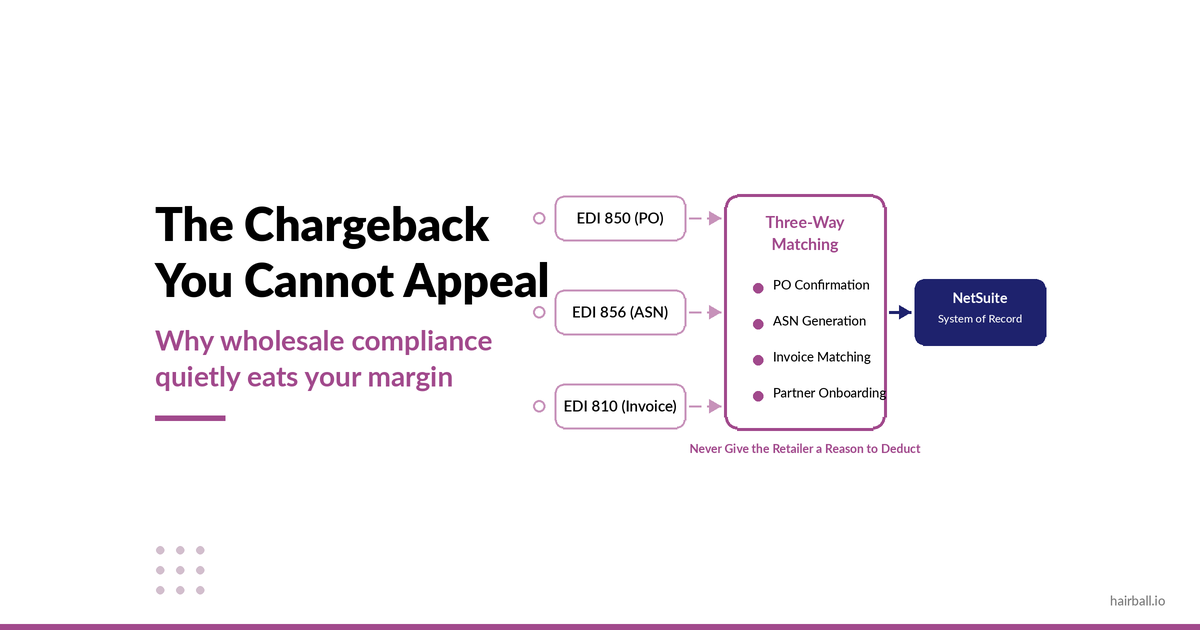
The technical building blocks of an 875 and 880 integration are similar to other order and invoice transactions in the X12 family, such as the more common EDI 850 and 810. The difference that matters in grocery is store-level allocation.
A single C&S purchase order can contain lines destined for many individual stores. In NetSuite, that one inbound 875 needs to become a separate sales order per store, so inventory commitment, fulfillment, and reporting all line up with how the goods actually ship. On the outbound side, multiple item fulfillments sometimes need to consolidate into a single 856 Advance Ship Notice, depending on what the trading partner requires. Some grocery and retail partners demand that consolidation. Others do not. Getting that decision right per partner is the part that separates a working integration from one that triggers chargebacks.
This is where the NetSuite saved search delivery layer earns its place. Once the EDI data lands in NetSuite, Hairball builds saved searches that auto-deliver formatted order, fulfillment, and invoice reports to the operations and finance teams who need them. The integration does not stop at moving the file. It surfaces the data where people already work.
Hairball as a Celigo and NetSuite Integration Partner
Hairball is an Inc. 5000 eCommerce operations consultancy and a top-tier Celigo and NetSuite partner. We build EDI integrations for mid-market product brands that sell through grocery distributors, big-box retailers, and marketplaces, and we connect those flows directly to NetSuite.
For the Collin Street Bakery and C&S project, that meant standing up the 875 and 880, handling the store-level sales order split, and wiring the 856 and acknowledgment flow to match what C&S expects. As a Celigo implementation partner, we treat each trading partner as its own configuration rather than forcing every retailer through one rigid template.
Key Takeaways
The 875 and 880 are the grocery industry’s purchase order and invoice. They behave like other X12 order and invoice transactions, but grocery adds store-level allocation, allowances, and promotional pricing. The hard part of the NetSuite integration is splitting one purchase order into many store-level sales orders and consolidating fulfillments into the right Advance Ship Notice per partner. Collin Street Bakery is now live on both transactions with C&S, running through NetSuite with Hairball as the Celigo integrations partner.
Frequently Asked Questions
What is EDI 875?
EDI 875 is the Grocery Products Purchase Order, an ANSI X12 document a grocery retailer or wholesaler sends to a supplier to order products. It includes UPC or SKU item numbers, quantities, requested delivery dates, and store location detail, and it often allocates lines across multiple stores in a single order.
What is the difference between EDI 875 and EDI 850?
EDI 880 is the Grocery Products Invoice. Suppliers send it to bill a grocery buyer for delivered goods. It carries itemized products, quantities, unit prices, totals, promotions, and allowances, and it usually follows the 875 and 856 so the buyer can reconcile the invoice against the order and the shipment.
What is EDI 880 used for?
HB Feedback includes pre-built survey templates, automated workflows, and role-based dashboards ready to use on day one. Our Scale and Enterprise plans include a dedicated Customer Success Manager to help you launch.
How do EDI 875 and 880 connect to NetSuite?
An inbound 875 is mapped to one or more NetSuite sales orders, split by store where the order allocates across locations. Item fulfillments generate the 856 Advance Ship Notice, and the NetSuite invoice generates the outbound 880. A Celigo integration moves the documents and maps the fields so the supplier’s teams work entirely inside NetSuite.
Who is a good Celigo partner for grocery EDI integration?
Hairball is a Celigo and NetSuite integration partner that builds grocery EDI flows, including the 875 and 880, for mid-market product brands selling through distributors like C&S. The work covers store-level sales order splitting, Advance Ship Notice consolidation, and the NetSuite saved search reporting layer that delivers order and invoice data to operations and finance. Depending on the trading partner load, brands engage us for a single build or an ongoing fully managed EDI relationship.
How long does an 875 and 880 integration take to implement?
Timeline depends on the trading partner’s requirements, the number of transaction sets, and whether store-level splitting and ASN consolidation are needed. Because the 875 and 880 follow the same X12 patterns as the more common 850 and 810, an experienced Celigo implementation partner can scope and build the flow without starting from scratch.