
Every brand that lands its first major retail account celebrates the purchase order and then, a few months later, discovers the fine print. The excitement of getting product onto a big retailer’s shelves is real and it should be. What nobody warns the finance team about is the second document that arrives after the orders start flowing, the one that does not celebrate anything. It is a deduction notice. The retailer shipped your product, sold it, and then quietly subtracted a penalty from what it owed you because an advance ship notice arrived nine minutes late, or a carton label used the wrong barcode symbology, or a document showed up in a format that did not match the routing guide. The brand did the work, moved the goods, and still lost margin to a fee it never saw coming. That’s the moment wholesale stops feeling like growth and starts feeling like a compliance exam you did not study for.
I have spent a long time inside this problem, first building commerce capability inside NetSuite and now running an operations consultancy that lives in it every day. The pattern is consistent across categories and across retailers. A brand that runs a clean direct to consumer operation assumes wholesale will be a simpler version of the same thing. Fewer orders, bigger quantities, more predictable buyers. In reality wholesale is a different discipline entirely, governed by rules the brand does not write and enforced by penalties the brand cannot easily appeal. EDI compliance is the name for that discipline, and getting it right is the difference between a wholesale channel that expands margin and one that slowly bleeds it.
Wholesale is not a bigger DTC order
The instinct that gets brands into trouble is treating a retail purchase order like a large consumer order. On the storefront side, a sale is a single clean event. The customer buys, you ship, the money posts, everyone agrees. A wholesale relationship with a major retailer is not one event. It’s a choreographed exchange of documents, each with its own timing window and its own compliance requirement, and the retailer grades you on every step. The purchase order comes in as an EDI 850. You confirm it. You ship against it and generate an advance ship notice, the EDI 856, inside a window that can be as tight as an hour after the truck leaves. You invoice with an EDI 810 that has to match the shipment exactly. Miss any beat in that sequence and the retailer does not call to work it out. It deducts.
This is why wholesale order processing demands a level of integration discipline that DTC never forced on the brand. The retailer is running its own supply chain on the assumption that every vendor speaks its document language fluently and on schedule. Its routing guide is not a suggestion. It’s a contract that dictates how product is labeled, how it’s packed, which carrier is used, when the ASN transmits, and what every document must contain. A brand that hand keys purchase orders into NetSuite and emails back a confirmation can survive at low volume. The moment that brand onboards with a Target, a Nordstrom, or any partner running a real EDI program, the manual approach becomes a chargeback machine. The volume is exactly what makes the penalties compound.
Why the ASN is where the money leaks
If I had to point to the single most expensive document in the entire wholesale relationship, it would be the advance ship notice. ASN compliance is where most brands take their heaviest chargeback losses, and the reason is timing. The ASN tells the retailer what is arriving, in what cartons, at what quantities, before the truck reaches the dock. The retailer’s receiving operation is built around that data. When the ASN is late, or inaccurate, or missing the carton detail the retailer expects, it throws off the entire receiving process at the other end, and the retailer prices that disruption into a deduction that comes straight out of your invoice.
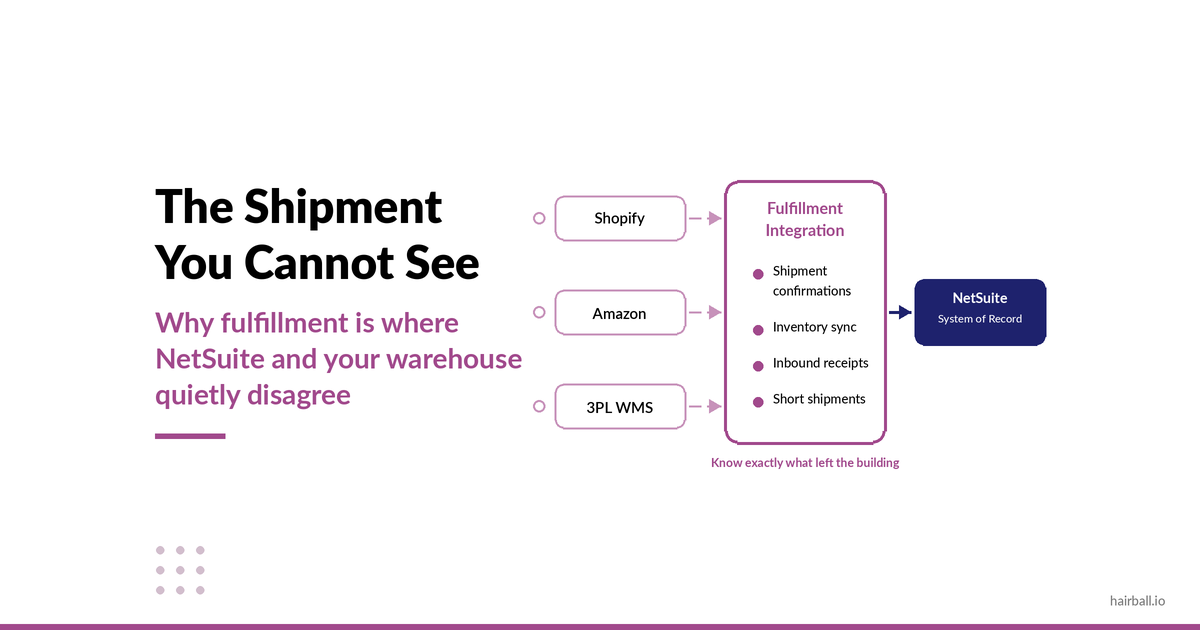
The trap is that the ASN cannot be generated correctly from planning data. It has to reflect what physically shipped, which means it depends on the warehouse and the fulfillment system telling NetSuite the truth about the shipment at the moment it happens. If your fulfillment handoff is even slightly out of sync, the ASN either transmits late because the ship confirmation lagged, or it transmits inaccurate because it was built from what you intended to ship rather than what actually went. Either way the retailer deducts. I have watched brands lose thousands per month to ASN penalties and blame the retailer for being harsh, when the real issue was that their EDI integration with NetSuite was firing off documents built on data the warehouse had not yet confirmed. The retailer was not being harsh. The document was simply wrong, and wrong is expensive in wholesale.
Three-way matching is the discipline that stops the bleeding
<p>The brands that run wholesale profitably share one habit that the brands losing margin do not. They match every purchase order against the shipment and the invoice before anything goes out the door. This is three-way matching, and it is the closest thing wholesale has to an insurance policy against chargebacks. The purchase order says what the retailer asked for. The ASN says what you shipped. The invoice says what you are billing. When those three documents agree, the retailer has nothing to deduct against, because the paper trail is clean and the physical shipment matches it. When they disagree, the gap between them is precisely the space where a chargeback lives.</p>
<p>The reason so few brands do this well is that three-way matching is genuinely hard to run by hand at volume. It requires that the purchase order, the fulfillment record, and the invoice all live in one place where they can be compared automatically, and for most brands that place is NetSuite. When the full chain from EDI 850 to sales order to fulfillment to EDI 810 invoice is wired so that each document is generated from the one before it rather than assembled independently, the matching happens as a natural byproduct of the flow. The invoice cannot say something the shipment did not, because the invoice is built from the shipment. That is what compliance looks like when it’s designed on purpose. The chargebacks do not get appealed after the fact. They never get issued in the first place, because the documents give the retailer no reason to issue them.</p>
Trading partner onboarding decides your ceiling
There is a quieter version of this problem that shows up before a single order flows, and it is trading partner onboarding. Every retailer has its own dialect of EDI. The document standards are shared, but each partner customizes the specifics, the qualifiers, the required segments, the exact labeling and packing rules in its routing guide. Onboarding a new trading partner means mapping that partner’s unique requirements into your own order to cash process so that every document you send speaks its dialect correctly from the first shipment. Brands that treat onboarding as a technical checkbox tend to go live with mappings that are almost right, and almost right in wholesale means chargebacks in the first ninety days, exactly when the retailer is deciding whether you are a vendor worth expanding.
The brands that scale their wholesale channel treat trading partner onboarding as the foundation it is. They invest in getting the mapping right before volume arrives, they test the full document exchange against the routing guide, and they build the process so that adding the next retailer is a repeatable exercise rather than a custom scramble. That discipline is what turns wholesale from a channel a brand tolerates into a channel a brand can grow, because each new partner comes online clean instead of costing a quarter of penalties while the team learns the retailer’s rules the hard way.
The unified picture finance actually needs
The last piece that separates a wholesale operation that scales from one that does not is what happens after the documents flow. B2B and DTC cannot live in two different financial worlds. When wholesale orders, ASNs, invoices, deductions, and payments all flow into NetSuite alongside the direct to consumer business, finance finally sees one picture instead of two. The controller can tell you the true margin of the wholesale channel after chargebacks, not just the gross revenue before them. That visibility is where the strategic conversation starts, because a brand that can see exactly what compliance is costing can decide what to fix, which partners are worth the effort, and where the margin is really coming from.
This is the work Hairball does every day. As a top Celigo implementation partner and a NetSuite continued success provider, we build and manage the full B2B order to cash process, from trading partner onboarding through compliant ASN and invoice generation to the three-way matching that keeps chargebacks from ever being issued. Wholesale should expand your margin, not quietly eat it. The brands that get EDI compliance right are not lucky. They designed the flow so the retailer never has a reason to deduct, and that design is the whole game. If your wholesale channel is growing and the deduction notices are growing with it, that is not the cost of doing business. It is a solvable integration problem, and solving it is exactly the kind of continued success work that turns a retail account from a compliance exam into the profitable channel it was supposed to be.